
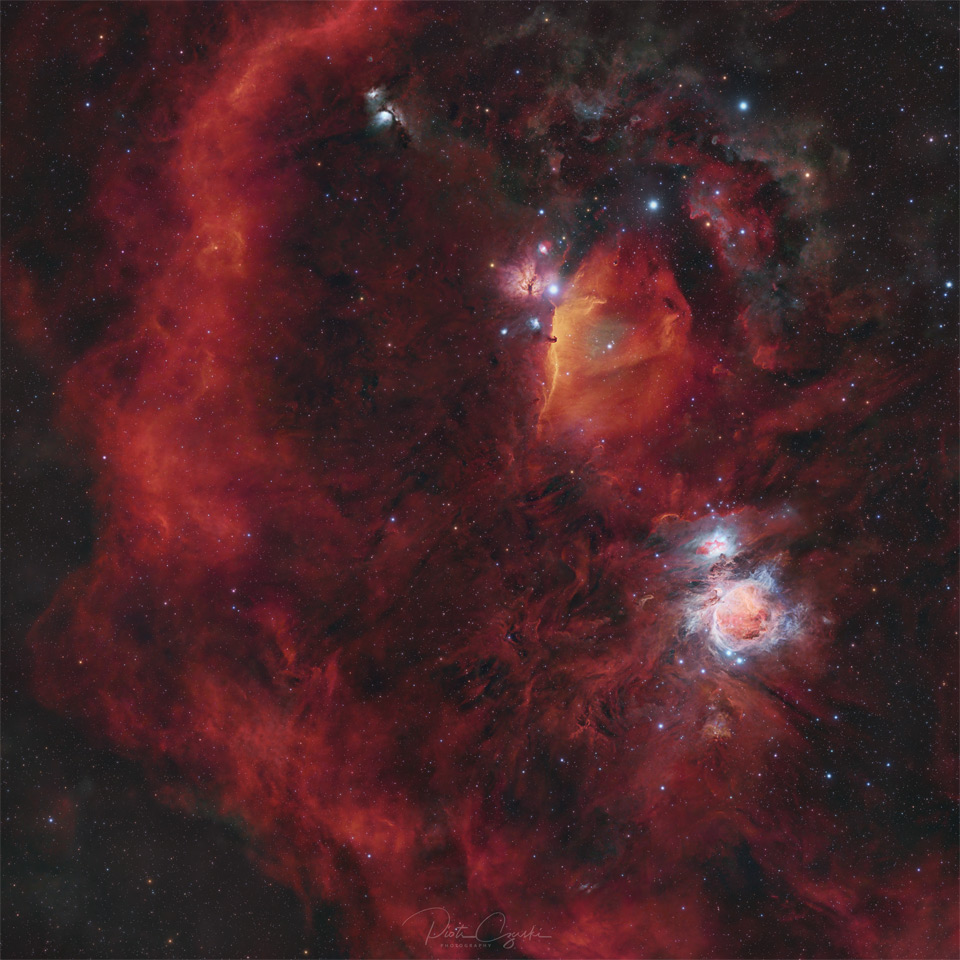
V Orionu se rodí mladé hvězdy, které se ukrývají v rudě zářícím vodíku. Tyto hvězdné jesle leží na okraji obřího komplexu molekulárního mračna Orion vzdáleného asi 1 500 světelných let. Podrobný pohled pokrývá asi 12 stupňů přes střed známého souhvězdí, přičemž vpravo dole je vidět hvězdotvorná oblast Velká mlhovina v Orionu. Hluboká mozaika zahrnuje poblíž středu nahoře také mlhovinu Plamen a mlhovinu Koňská hlava. Obrazová data získaná pomocí vodíkového alfa filtru přidávají tomuto širokoúhlému vesmírnému pohledu další pozoruhodné rysy: všudypřítomné úponky energeticky aktivního atomárního vodíku a části okolní Barnardovy smyčky. Zatímco Mlhovina v Orionu a mnohé hvězdy v Orionu jsou snadno pozorovatelné pouhým okem, emise z rozsáhlého mezihvězdného plynu jsou slabé, aby se daly zaznamenat i na teleskopických pohledech na komplex bohatý na mlhoviny.
Cradled in red-glowing hydrogen gas, stars are being born in Orion. These stellar nurseries lie at the edge of the giant Orion molecular cloud complex, some 1,500 light-years away. This detailed view spans about 12 degrees across the center of the well-known constellation, with the Great Orion Nebula, the closest large star-forming region, visible toward the lower right. The deep mosaic also includes, near the top center, the Flame Nebula and the Horsehead Nebula. Image data acquired with a hydrogen-alpha filter adds other remarkable features to this wide-angle cosmic vista: pervasive tendrils of energized atomic hydrogen gas and portions of the surrounding Barnard’s Loop. While the Orion Nebula and many stars in Orion are easy to see with the unaided eye, emission from the extensive interstellar gas is faint and much harder to record, even in telescopic views of the nebula-rich complex.
Via APOD & Astronomický snímek dne
